Free Korean Sool Tasting Note Tracker: How to Record Makgeolli, Soju, and Yakju
Most beginners struggle to describe what they taste in Korean sool. Is it sweet? Sour? Light? Complex? Without a system, these sensory impressions quickly fade, leaving you with only a vague memory of "I liked it" or "it wasn't my style."
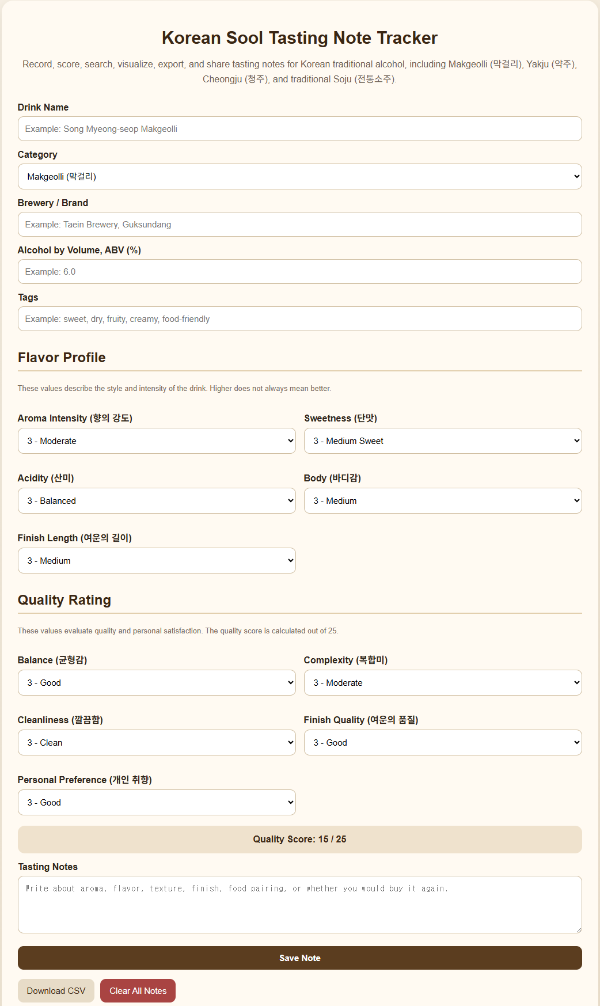
That’s why I created the Korean Sool Tasting Note Tracker. It is a practical, browser-based tool designed to help you master makgeolli tasting notes and soju tasting notes with zero technical effort.
Table of Contents
- 1. Why Tasting Notes Help You Enjoy Korean Sool
- 2. What the Korean Sool Tasting Note Tracker Does
- 3. How to Use the Tracker Step by Step
- 4. Flavor Profile vs Quality Rating: Our USP
- 5. How to Build Your Own Korean Sool Memory
- 6. Frequently Asked Questions
👉 Try the free Korean Sool Tasting Note Tracker now (no login required)
1. Why Tasting Notes Help You Enjoy Korean Sool
As explained in our guide on Makgeolli vs Soju vs Yakju differences, each category has a unique profile. Korean sool is diverse, using various types of rice, water, and traditional fermentation starters (Nuruk).
If you do not record your impressions, you lose the opportunity to find patterns in what you enjoy. A structured Korean sool tasting note helps you identify if you prefer the lactic acidity of rustic brews or the clean elegance of clear spirits, turning a fleeting taste into a useful record.
2. What the Korean Sool Tasting Note Tracker Does
This tracker is specifically optimized for the unique characteristics of traditional Korean drinks. It goes beyond simple star ratings, providing a deep dive into the beverage's DNA.
| Feature | Purpose |
|---|---|
| Drink Name & Category | Differentiate between Makgeolli, Yakju, Soju, and Cheongju easily. |
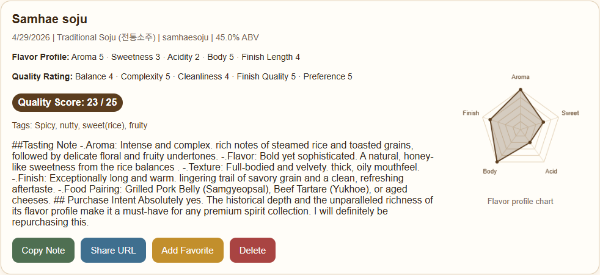
| Flavor Profile Radar Chart | Visualize aroma intensity, sweetness, acidity, body, and finish length at a glance. |
| Quality Scoring System | A professional-style 25-point evaluation for balance and complexity. |
| One-Click CSV Export | Download your notes for personal archiving or sharing. |
Don't let your flavor memories vanish.
👉Open the Free Tasting Note Tracker3. How to Use the Tracker Step by Step
Step 1 Enter the Basics
Input the name, brewery, and ABV. If you are a beginner, starting with smooth and easy makgeolli picks is a great way to learn how different ABV levels affect the body.
Step 2 Define the Style
Use the Flavor Profile Radar Chart to mark intensity. Is the aroma powerful? Is the finish short or lingering? This builds the visual "fingerprint" of the drink.
Step 3 Evaluate Quality
Rate the balance and complexity. Try entering your first tasting note now—it takes less than 1 minute.
4. Flavor Profile vs Quality Rating: Our USP
Unlike many simple tasting tools, this tracker clearly separates flavor profile (style) from quality evaluation, allowing for more objective analysis.
Sweetness, acidity, and body describe "what the drink is like," while quality ratings ask "how well it works." For example, a drink can have high acidity (Flavor Profile), but if that acidity is sharp and unpleasant, the "Quality Rating" for balance would be low. This distinction helps you judge the skill of the brewer independently of your personal taste.
5. How to Build Your Own Korean Sool Memory
The more you record, the more valuable your database becomes. After five or ten entries, you may begin to see clear preferences. You might find you naturally gravitate toward dry makgeolli with bright acidity or traditional soju with a long, grain-forward finish.
6. Frequently Asked Questions
❓ Is the Korean Sool Tasting Note Tracker free?
Yes. The Korean Sool Tasting Note Tracker is free to use in your browser. No app installation or login is required.
❓ Are my saved tasting notes public?
No. Your saved tasting notes are stored only in your own browser using local storage. Other visitors cannot see your notes unless you choose to share a specific tasting note URL.
❓ What is the best way to taste makgeolli?
For the best experience, taste the clear upper layer first to identify delicate aromas, then mix the sediment to evaluate the full creamy body and texture.
❓ What is the difference between Flavor Profile and Quality Rating?
Flavor Profile describes the style and intensity (e.g., how sweet it is), while Quality Rating evaluates the skill of the brew (e.g., how balanced and clean it is).
Conclusion
Korean traditional alcohol becomes far more interesting when you pay attention to the details. Tasting notes help you move beyond simple likes and dislikes to a deeper understanding of balance, texture, and aroma.
Start your first tasting note today and build your personal Korean sool database.
👉 Open the Free Tasting Note Tracker'Guide' 카테고리의 다른 글
| Top 5 Soju for Enthusiasts (Traditional & Craft Only) (0) | 2026.04.28 |
|---|---|
| Best Makgeolli for Beginners: Smooth and Easy Picks (0) | 2026.04.22 |
| How to Drink Makgeolli Properly (Beginner Guide + Mistakes to Avoid) (0) | 2026.04.22 |
| Why Makgeolli Explodes (And How to Prevent It) (0) | 2026.04.22 |
| How Long Does Makgeolli Last? Makgeolli Shelf Life Guide (0) | 2026.04.22 |


