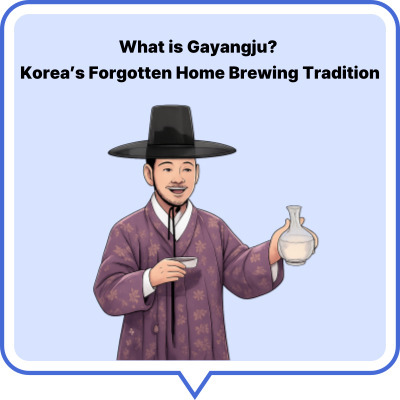
Korea was once a country where making alcohol at home was part of everyday life. Long before modern brands existed, families brewed their own rice wine using rice, water, and nuruk. This tradition is known as Gayangju, the soul of Korean fermentation.
Table of Contents
- 1. Defining Gayangju: The Philosophy of Homemade Alcohol
- 2. Social Importance: Rituals, Hospitality, and Community
- 3. Historical Context: The Golden Age of Joseon Dynasty
- 4. Global Comparison: Gayangju vs. European Farmhouse Traditions
- 5. The Decline: Modern Challenges and Preservation
- 6. Conclusion
1. Defining Gayangju: The Philosophy of Homemade Alcohol
Gayangju (가양주) literally means "household alcohol." Unlike modern standardized products, Gayangju was a living reflection of a family's environment. The flavor changed based on the water quality of the well, the local temperature, and the specific recipe passed down through generations. This created a diverse spectrum of tastes that we often discuss when exploring the history of Korean traditional alcohol.
The concept of Myeongga Myeongju (Famous House, Famous Liquor) was central to this culture. A well-respected household was expected to serve high-quality, clear alcohol to guests. If the alcohol was sour or poorly made, it was often seen as a sign of lack of discipline within the family. In this sense, Gayangju was a matter of family pride and honor.
2. Social Importance: Rituals, Hospitality, and Community
In traditional Korean society, alcohol was not just for pleasure; it was a social necessity. Its role was divided into three main pillars:
✔️ Confucian Rituals and Ancestral Rites
During the Joseon Dynasty, ancestral rites (jesa) were the foundation of family values. Clear, well-brewed alcohol was the primary offering to spirits. This ritualistic demand ensured that every household maintained at least a basic knowledge of the differences between Makgeolli, Soju, and Yakju, as different ceremonies required specific types of liquor.
✔️ Hospitality and Juju Gaekban
Korea’s hospitality culture, known as Juju Gaekban, meant that a host should always be ready to offer alcohol to a guest. Because guests could arrive at any time, a jar of fermenting rice wine was a permanent fixture in the Korean kitchen. This mirrors the way locals traditionally drink Makgeolli even today—as a social bond rather than just a drink.
3. Historical Context: The Golden Age of Joseon Dynasty
The Joseon Dynasty is widely considered the peak of Gayangju culture. Before this era, brewing was often centralized in Buddhist temples. However, as the state adopted Confucianism, the duty of brewing shifted to the women of each household. This decentralization led to thousands of unique recipes blooming across the peninsula. Each family had their own secret ratio of nuruk and rice, similar to how modern connoisseurs debate how to choose the right Makgeolli today.
4. Global Comparison: Gayangju vs. European Farmhouse Traditions
To help global readers understand, Gayangju can be compared to the Farmhouse Ale traditions of Europe or the Home Vineyards of Italy and France. Just as a Belgian farmer would brew a seasonal Saison using local wild yeast, a Korean family brewed rice wine using nuruk—a starter made from wheat or rice that captured local wild molds and yeasts.
| Feature | Gayangju (Korea) | Farmhouse Ale (Europe) |
|---|---|---|
| Primary Ingredient | Rice | Barley / Wheat |
| Starter Culture | Nuruk (Wild Mold/Yeast) | Yeast (Saccharomyces) |
| Social Context | Ancestral Rituals / Hospitality | Laborers' Hydration / Seasonal Fests |
The main difference lies in the enzymes. While malted grain provides enzymes in beer, nuruk provides both the enzymes and the yeast simultaneously, making Gayangju a unique "parallel fermentation" drink that shares some DNA with Japanese Sake, yet remains far more rustic and diverse.
5. The Decline: Modern Challenges and Preservation
Sadly, this vibrant culture faced a sharp decline. Japanese colonial policies in the early 20th century taxed home brewing heavily, effectively banning Gayangju to prioritize commercial alcohol taxes. Later, industrialization and urbanization made the slow, temperature-sensitive process of home fermentation nearly impossible in modern apartments. Today, many people rely on commercial options, often forgetting why Makgeolli needs refrigeration and the living nature of the drink.
6. Conclusion
Gayangju is more than just a method of making alcohol; it is a philosophy of patience and respect for nature. It represents a time when every glass had a story and every household had a signature scent of fermenting rice. Although commercialization has taken over, understanding the roots of Gayangju allows us to appreciate Korean traditional alcohol with much greater depth.
In my upcoming post, I will share my personal journey of attempting to recreate this "forgotten" tradition in my own kitchen. Stay tuned for a detailed log of my first home-brewing experience!
❓ What does Gayangju taste like?
Because it is unfiltered and natural, it usually has a much deeper, more complex acidity and creaminess compared to mass-produced rice wines.
❓ Is it legal to brew Gayangju at home today?
Yes, home brewing for personal consumption is legal in Korea, though selling it without a commercial license is strictly prohibited.
'culture' 카테고리의 다른 글
| How Koreans Used Alcohol to Share Joy and Sorrow (0) | 2026.04.20 |
|---|---|
| The Three Great Traditional Korean Liquors of the Joseon Dynasty (0) | 2026.04.16 |
| Soju Brands Featured in Itaewon Class Explained (0) | 2026.04.16 |
| Korean Alcohol Seen in Squid Game: What Are They Drinking? (0) | 2026.04.15 |
| The History of Korean Traditional Alcohol: From Past to Present (0) | 2026.04.12 |


